Tai Chi 24&48 Simplified Form
YMAA Publication Center, Inc. Santé et Fitness 4+ £9.99
Meilleure position maintenant
#32
à travers 2 vitrines
Pic
#12Jours suivis
10 Historique des graphiques
10 jours enregistrés par nous
Vitrines
graphique en 2 aujourd'hui
Évaluations
aucun pour l'instant
Prix
changé 3 fois dans notre fenêtre
Installations et revenus
Apple ne publie rien — nous ne devinons pas
Actuellement dans le classement
Historique
Construit à partir des propres instantanés quotidiens d'Astrina — un point par jour.
Position dans le graphique — 🇫🇷 Meilleurs payants
09.09 10.09 11.09
Afficher les chiffres
| Jour | Position |
|---|---|
| 09.09 | #12 |
| 10.09 | #20 |
| 11.09 | #32 |
Nombre d'évaluations
23.07 24.07 30.08
Afficher les chiffres
| Jour | Évaluations |
|---|---|
| 23.07 | 0 |
| 24.07 | 0 |
| 21.08 | 0 |
| 30.08 | 0 |
Captures d'écran



À propos de cette application
Learn the most popular forms of Tai Chi in the world from a Grandmaster.
• 2.5 hours of streaming video lessons.
• Learn quickly with 24 easy Tai Chi movements.
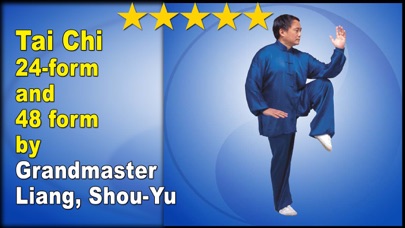
• Beautiful Tai Chi forms by Grandmaster Liang, Shou-Yu.
• Learn martial applications for each of the 24 movements.
• Includes a bonus demonstration of the 48 form.
The short forms are based upon Yang-style Tai Chi movements.
Tai Chi Chuan is an ancient internal Chinese martial art which has gained widespread popularity for its many health benefits. Today, most people practice taiji slowly to develop their balance, strength, and vitality, and the martial applications of the art are often ignored.
Also spelled Taijiquan, 'Grand Ultimate Fist' is a highly effective form of combat specializing in short and middle-range fighting.
In China, t'ai chi ch'uan is categorized under the Wudang grouping of Chinese martial arts, which are applied with internal power (jing), using Qi (energy). The history of the basic postures in the Yang form can be traced back through Wudang mountain to Shaolin Temple, developed from a series of movements originating from "Chang Quan" (Long Fist, a reference to the winding Long River, another name for the Yangtze). Around 800 AD, a philosopher named Xu, Xuan-Ping is credited for developing a long Kung Fu of 37 forms, which included these common Tai Chi movements:
• Play the Guitar
• Single Whip
• Step Up to Seven Stars
• Jade Lady Works the Shuttles
• High Pat on Horse
• Phoenix Flaps Its Wings
"Taiji Chang Quan" existed in many variations, and eventually evolved into Taijiquan. Other forms of the same era such as "Heavenly-Inborn Style", "Nine Small Heavens", and "Acquired Kung Fu" also show similarities to what later became Taijiquan. The principles of softness, sticking, adhering, and using the opponent's own momentum against himself were established in these precursory martial styles. Bodhidharma's teaching at the Buddhist Shaolin Temple around 550AD, which detailed the theory of using the mind to lead the Qi to energize the physical body, is widely considered the origin of all Internal Martial Arts, including Tai Chi.
Grandmaster Liang's martial arts ancestry originated five generations ago. He started his traditional Emei kungfu and Qigong training with his grandfather in 1948. Grandmaster Liang then sought out other renowned masters and other styles from Shaolin and Wudang. In the early sixties, Grandmaster Liang began his study and research in the few major styles of Taiji such as Yang, Chen, Sun, and Wu style, Buddhist Esoteric Qigong, and Taoist Qigong. Grandmaster Liang has many times been a gold medalist in Wushu and Taiji competitions held in Sichuan province. Grandmaster Liang lives and teaches in Vancouver, Canada.
Thank you for downloading our app! We are striving to make the best possible video apps available.
Sincerely,
The team at YMAA Publication Center, Inc.
(Yang’s Martial Arts Association)
CONTACT: [email protected]
VISIT: www.YMAA.com
WATCH: www.YouTube.com/ymaa
• 2.5 hours of streaming video lessons.
• Learn quickly with 24 easy Tai Chi movements.
• Beautiful Tai Chi forms by Grandmaster Liang, Shou-Yu.
• Learn martial applications for each of the 24 movements.
• Includes a bonus demonstration of the 48 form.
The short forms are based upon Yang-style Tai Chi movements.
Tai Chi Chuan is an ancient internal Chinese martial art which has gained widespread popularity for its many health benefits. Today, most people practice taiji slowly to develop their balance, strength, and vitality, and the martial applications of the art are often ignored.
Also spelled Taijiquan, 'Grand Ultimate Fist' is a highly effective form of combat specializing in short and middle-range fighting.
In China, t'ai chi ch'uan is categorized under the Wudang grouping of Chinese martial arts, which are applied with internal power (jing), using Qi (energy). The history of the basic postures in the Yang form can be traced back through Wudang mountain to Shaolin Temple, developed from a series of movements originating from "Chang Quan" (Long Fist, a reference to the winding Long River, another name for the Yangtze). Around 800 AD, a philosopher named Xu, Xuan-Ping is credited for developing a long Kung Fu of 37 forms, which included these common Tai Chi movements:
• Play the Guitar
• Single Whip
• Step Up to Seven Stars
• Jade Lady Works the Shuttles
• High Pat on Horse
• Phoenix Flaps Its Wings
"Taiji Chang Quan" existed in many variations, and eventually evolved into Taijiquan. Other forms of the same era such as "Heavenly-Inborn Style", "Nine Small Heavens", and "Acquired Kung Fu" also show similarities to what later became Taijiquan. The principles of softness, sticking, adhering, and using the opponent's own momentum against himself were established in these precursory martial styles. Bodhidharma's teaching at the Buddhist Shaolin Temple around 550AD, which detailed the theory of using the mind to lead the Qi to energize the physical body, is widely considered the origin of all Internal Martial Arts, including Tai Chi.
Grandmaster Liang's martial arts ancestry originated five generations ago. He started his traditional Emei kungfu and Qigong training with his grandfather in 1948. Grandmaster Liang then sought out other renowned masters and other styles from Shaolin and Wudang. In the early sixties, Grandmaster Liang began his study and research in the few major styles of Taiji such as Yang, Chen, Sun, and Wu style, Buddhist Esoteric Qigong, and Taoist Qigong. Grandmaster Liang has many times been a gold medalist in Wushu and Taiji competitions held in Sichuan province. Grandmaster Liang lives and teaches in Vancouver, Canada.
Thank you for downloading our app! We are striving to make the best possible video apps available.
Sincerely,
The team at YMAA Publication Center, Inc.
(Yang’s Martial Arts Association)
CONTACT: [email protected]
VISIT: www.YMAA.com
WATCH: www.YouTube.com/ymaa
Détails
| Développeur | YMAA Publication Center, Inc. |
|---|---|
| Catégorie | Santé et Fitness |
| Prix | £9.99 |
| Classification par âge | 4+ |
| Version | 1.0.3 |
| Taille | 13.6 MB |
| iOS minimum | 11.0 |
| ID de bundle | com.ymaa.taichi2448 |
| Publié | 2015-04-04 |
| Dernière mise à jour | 2023-01-16 |
| Langues | 1 langues |
Ce que cette page répond
- Tai Chi 24&48 Simplified Form critiques d'application
- Tai Chi 24&48 Simplified Form évaluation d'application
- Tai Chi 24&48 Simplified Form téléchargement
- Tai Chi 24&48 Simplified Form classement de l'App Store
- avis sur Tai Chi 24&48 Simplified Form
- avis et évaluations de Tai Chi 24&48 Simplified Form
- est Tai Chi 24&48 Simplified Form légitime
- est Tai Chi 24&48 Simplified Form une arnaque
- avis d'utilisateurs réels de Tai Chi 24&48 Simplified Form
- évaluation de Tai Chi 24&48 Simplified Form
- plaintes concernant Tai Chi 24&48 Simplified Form
- ce que les gens disent de Tai Chi 24&48 Simplified Form
- avis Tai Chi 24&48 Simplified Form application
- avantages et inconvénients de Tai Chi 24&48 Simplified Form
- expérience de Tai Chi 24&48 Simplified Form
- devrais-je faire confiance à Tai Chi 24&48 Simplified Form
- retour d'expérience de Tai Chi 24&48 Simplified Form
- avis sur Tai Chi 24&48 Simplified Form 2026
- vérification de Tai Chi 24&48 Simplified Form
- vérification de sécurité de Tai Chi 24&48 Simplified Form
